
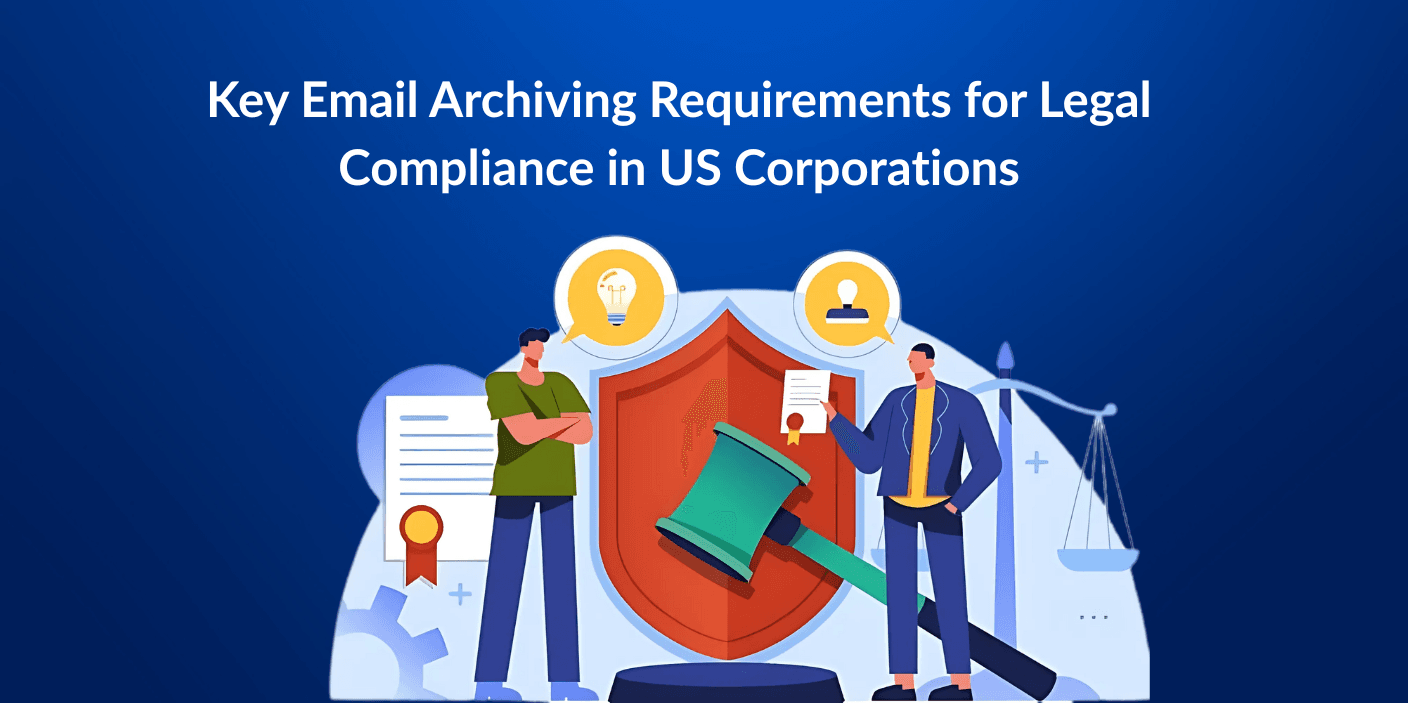
In today’s litigious business environment, email archiving isn’t just about storage—it’s about survival.
Whether it’s a lawsuit, an audit, or a regulatory investigation, your company’s ability to retrieve historical emails instantly and accurately can make or break your case.
Let’s dive into the email archiving requirements US corporations must meet to stay compliant, especially as legal scrutiny around data governance continues to tighten in 2025.
1. What Is Email Archiving?
Email archiving is the automated, long-term storage of email communications in a secure, searchable format.
But for legal compliance, it must go beyond backups. True email archiving must:
- Preserve the original format and content
- Be tamper-proof
- Include metadata (timestamp, sender, recipient, IP, etc.)
- Be searchable and retrievable on demand
📌 Bottom line: If your email system can’t prove what was said, when, and by whom—it won’t hold up in court.
2. Why Email Archiving Is Legally Required in the US
Several federal regulations require email retention and auditability. Key laws include:
| Regulation | Industry Impacted | Email Archiving Requirement |
|---|---|---|
| SEC Rule 17a-4 | Financial Services | Must retain all business-related communications for 3–7 years |
| Sarbanes-Oxley (SOX) | Public Companies | Must store records related to financial reporting |
| HIPAA | Healthcare | Must retain protected health info, including via email |
| FRCP (Federal Rules of Civil Procedure) | All Industries | Emails must be producible in legal discovery |
| FINRA | Brokerage Firms | Requires retention of all customer/business-related messages |
⚖️ Legal Insight: Even if your industry isn’t highly regulated, FRCP applies to all corporations during legal proceedings.
3. Core Email Archiving Requirements for Legal Compliance
Here’s what your email archiving system must do to stay compliant:
✅ 1. Immutable Storage (WORM)
Emails must be stored in a Write Once, Read Many (WORM) format—so no one can alter them after archiving.
✅ 2. Retention Policy Management
You need to define and automate how long emails are stored based on legal requirements—3, 5, or 7+ years.
✅ 3. Legal Hold Capability
When litigation arises, the system must allow admins to lock specific email records to prevent deletion or tampering.
✅ 4. Advanced Search & Retrieval
You must be able to find and retrieve specific emails quickly using filters like sender, subject, date, and keywords.
✅ 5. Audit Trails & Logs
Your system must maintain detailed logs of all access, retrievals, and changes made—especially during audits or discovery.
4. How Long Should Emails Be Retained?
Retention periods vary by regulation:
| Regulation | Minimum Retention Period |
|---|---|
| SEC Rule 17a-4 | 6 years (non-erasable) |
| Sarbanes-Oxley | 7 years |
| HIPAA | 6 years |
| IRS (for tax records) | 7 years |
| General Business | 3–5 years recommended |
📌 Pro Tip: Always consult with legal counsel to define your company’s custom retention policy.
5. On-Prem vs Cloud Archiving: What’s Better for Compliance?
| Feature | On-Prem | Cloud-Based |
|---|---|---|
| Setup & Maintenance | High effort | Low maintenance |
| Compliance Updates | Manual | Automatic |
| Scalability | Limited | Flexible |
| Cost | High upfront | Subscription-based |
| Legal Hold, Audit Logs | May require add-ons | Often built-in |
🌐 2025 Trend: More corporations are moving to cloud-based archiving platforms that auto-update to meet changing legal standards.
6. Common Mistakes That Can Lead to Penalties
Avoid these critical errors:
- ❌ Relying on inbox backups instead of a proper archive
- ❌ Failing to enforce retention policies consistently
- ❌ Inability to prove chain of custody during audits
- ❌ No legal hold functionality in place
- ❌ Manual deletion of records without oversight
7. How Solutions Like YourDMARC Enhance Compliance
While DMARC protects your domain, YourDMARC can work alongside your archiving tool to:
- Identify phishing attempts before they reach inboxes
- Ensure email authentication is logged properly
- Provide real-time visibility into suspicious email activity
- Help demonstrate proactive email security practices in audits
🛡️ Bonus Benefit: Showing you actively protect and archive email communications strengthens your legal and brand credibility.
8. Best Practices for 2025
To stay fully compliant with email archiving laws:
- ✅ Use a cloud-based archiving platform with legal hold support
- ✅ Set up automated retention schedules
- ✅ Ensure storage is tamper-proof (WORM)
- ✅ Integrate archiving with email authentication tools
- ✅ Conduct quarterly internal audits
- ✅ Train employees on email compliance policies
Conclusion
In 2025, email archiving isn’t just about saving space—it’s about protecting your business from legal risk.
With regulators, litigators, and cybercriminals paying close attention to your email practices, make sure your archiving system is secure, searchable, and legally defensible.
And if you're looking for all-in-one visibility, pair your email archive with YourDMARC for complete compliance, security, and peace of mind.